|
|
|
|
|
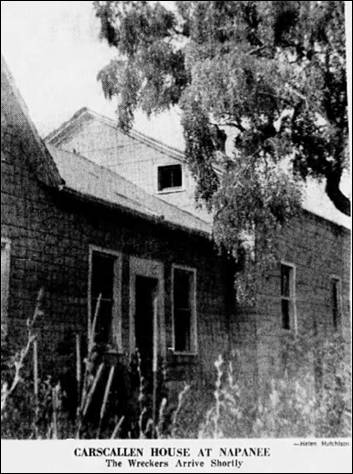
Half-hidden behind a tangle of burdocks and Manitoba
maples, the Luke Carscallen house on the River Road, dowager of Napanee homes,
awaits the wrecker’s hammer. Already the tearing down has begun on the west
end of the house, a wing added later to the original house. Long before demolishers began, this house was a
wreck. The windows are out, the doors are either missing or
ajar on broken hinges. It is surrounded by the debris of half a dozen tenant
families, debris partly concealed by a jungle growth of weeds. Nevertheless, under the neglect, filth and vandalism,
there still exists a basically sound house, a fine example of a builder’s
skill and taste in the first decade of the 1800’s. Architecturally, the house is one that ought to be
preserved. But in its present state, the house blights redevelopment plans for
the area around it. Nevertheless, when this house is gone, the town of
Napanee will have lost a part of its character, trradition and heritage, just
as it diid when the mill at the falls crumbled. Respect for its past comes slowly to a pioneer
community interested in getting ahead. Luke Carscallen was a United Empire Loyalist with a
superb eye for setting. He built his home on the crest of a gentle slope
above the Napanee River, on a little bay where red-wing blackbirds swing on
bulrushes as they trill their liquid notes. The river was at his front door.
His back door looked down on a small stream spanned by a footbridge. Taking advantage of the sloping southern exposure,
Luke Carscallen bult what present day builders call a split level. The door
of the basement kitchen opened directly outside at ground level and was
flanked by two windows. A few small panes of glass are left in one of them,
indicating the early design of the house. In the first of the two basement rooms, under low
beams that are hand-hewn, are built-in cupboards, against the thick stone
foundations. In spite of their present dilapidation they are startingly like
the cupboards in a modern kitchen. It is not hard to imagine the Carscallen men coming
in on a hot summer day from the meadows, crossing the footbridge, washing
sweat from tired faces at an outdoor wash bench and entering the coolness of
a basement kitchen for their substantial meal. A south door in the main house leads directly into a
large keeping room which no doubt served in winter as a kitchen. This room
must have had a fireplace, which may have been taken out when a woodshed was
built on the west end. The covered staircase rising from the keeping room
leads to a gallery type corridor. On either side is a bedroom under the
eaves. These rooms were probably unheated and occupied by servants or the boys
of the family. Luke Carscallen was an Irishman who had served in the
British army and emigrated to the 13 colonies. Luke defied the
revolutionaries in the War of Independence and had to flee. The rebels
threatened his young son with hanging if he did not tell his father’s hiding
place. “Hang away,” the young boy is said to have told the
rebels. Three times he was strung up, but he lived and did not reveal his
father’s whereabouts. The deed to 200 acres, Lot 16 in the 6th
concession of North Fredericksburgh is registered Sept. 19, 1805. The house may
have been built at that date, or registered after the building was up. Maps
of early Napanee and North Fredericksburgh show a large tract of land along
the River Road registered to Luke Carscallen. Two of Isaac’s son, Thomas and John, grandsons of
Luke, the Loyalist pioneer, became wardens of Lennox and Addington County.
John, in 1900, was elected to the Legislative Assembly of Ontario, where he
served for many years. A quit claim deed registered in 1878 between James F.
Miler and Luke Carscallen indicated the land was passing out of Carscallen
hands. For many years in the 20th century, it belonged to Frank
McCutcheon, whose hired man occupied the Carscallen home. The Carscallen house is now part of a river lot
development project. To the west are several new homes, built on the water, providing
year-round living as well as summer fun on the river. A short distance to the
east is the new Rotary Swimming Pool. Ten years ago, the riverfront area of Napanee was the
poor section of town. Talk of a green belt and the new homes on the river,
have changed the attitudes of people and civic officials. The present owner of the Carscallen house has offered
it and the lot, for the price of a riverfront lot in the area. No buyer has
come forward, and he has been forced to let the contract for its demolition. |