
|
|
|
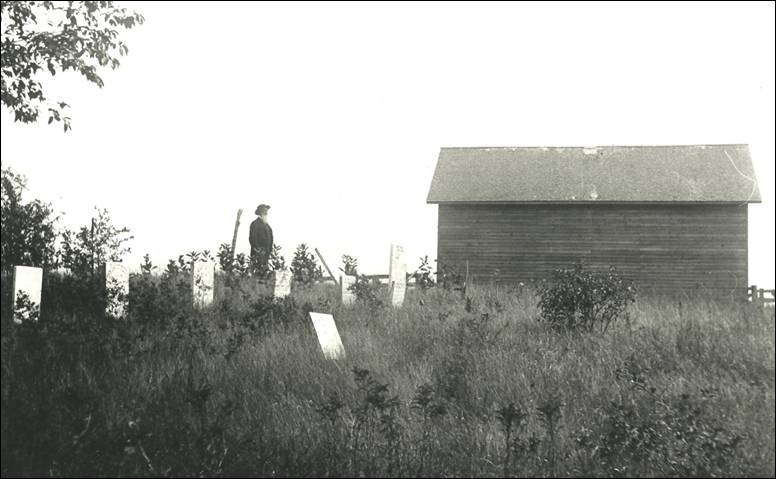
The Old Quaker Meeting House The old Meeting House was
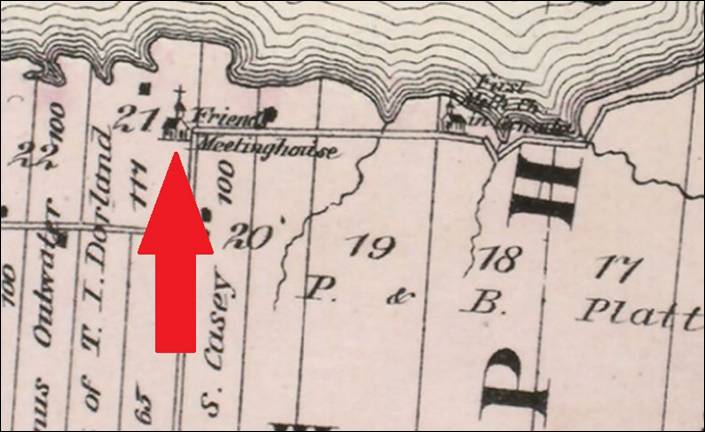
located on the third concession of Adolphustown, just north of Dorland. The building is long gone,
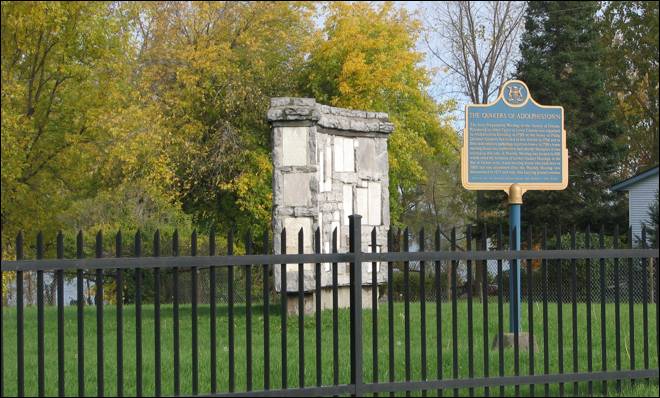
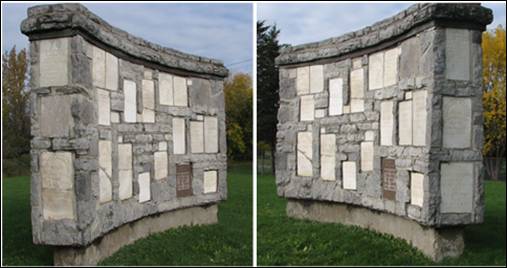
but the old stones from the surrounding cemetery have been preserved in a
memorial wall and the site marked as an
Ontario Historic Site. “In Tenth Month, 1798, it was proposed to erect a
meeting house at Adolphustown. The committee entrusted with this duty
reported, that having taken the matter into consideration, unite in proposing
to commence building a house thirty feet by twenty-five feet, with eighteen
foot posts. After solemn consideration, this was agreed upon and James Noxon,
Aaron Brewer and John Dorland were appointed to consider a suitable spot of
ground. A site was found on a corner of the farm of John Dorland, on the
south shore of Hay Bay, which was also to serve as a burying ground. James
Noxon and John Dorland were appointed to have oversight of the burying ground
and to admit such persons to inter their dead there as are willing to conform
to the good order used among Friends. This implied restriction referred to
the plain headstones of a more or less uniform shape and height, upon which
Friends insisted as being consistent with their simplicity in other matters.
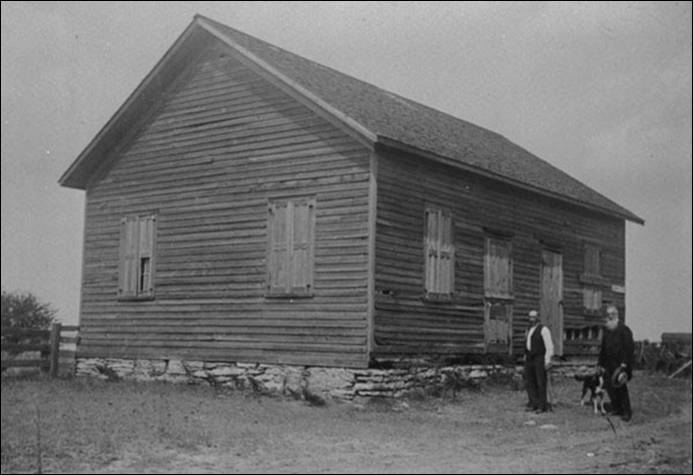
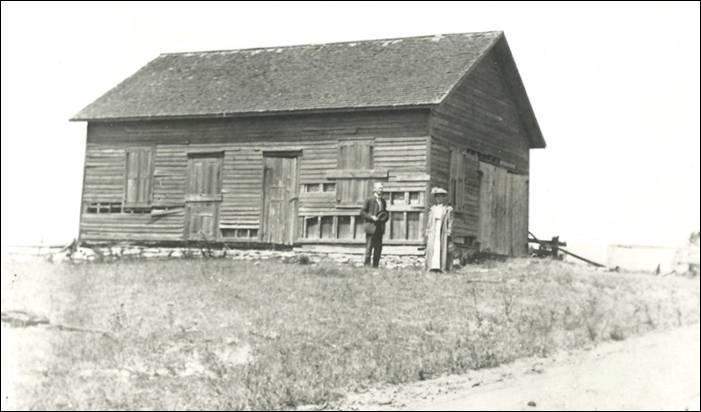
On a corner of the old burying ground stood the meeting house which was
probably the third oldest place of public worship in Upper Canada. In 1868,
the meeting house was pulled down and replaced by another building on the
same site. After Adolphustown Meeting was laid down in 1871, the meeting
house fell into disrepair and was finally disposed of in 1897.” A History of the Society of Friends (Quakers) in
Canada, Arthur Garratt Dorland, 1927 “I felt a strong inclination one Sabbath morning to
visit the old Quaker Meeting House about three miles away. After making my
toilette and breakfasting, I sallied forth on foot and alone, through the
fields and woods. At length I arrived at the old meeting-house where I had
often gone, when a lad with father and mother. It was a wooden building standing at a corner of the
road and was among the first places of worship erected in the Province. The
effects of the beating storms of nearly half a century were stamped on the
unpainted clapboards and the shingles which projected just far enough over
the plate to carry off the water, were worn and partially covered with moss.
One would look in vain for anything that could by any possibility be claimed
as an ornament. Two small doors gave access to the interior, which was as
plain and ugly as the exterior. A partition, with doors, that were let down
during the time of worship, divided the room into equal parts and separated
the men and women. It was furnished with strong pine benches, with backs; and
at the far side were two rows of elevated benches, which were occupied on
both sides by leading members of the society. I have often watched the row of
broad-brims on one hand and the scoop bonnets on the other, with boyish
interest and wondered what particular thing in the room they gazed at so
steadily and why some of them twirled one thumb round the other with such
regularity. On this occasion I entered quietly and took a seat near the door.
There were a number of familiar faces in the audience. Some whom I had known
when young were growing grey, but many of the well-remembered faces were
gone. The gravity of the audience and the solemn silence were very
impressive; but still recollections of the past crowded from my mind the
sacred object which had brought the people together. Now I looked at the old
bayonet marks in the posts, made by the soldiers who had used it as a barrack
immediately after the war of 1812. Next, the letters of all shapes and sizes
cut by mischievous boys with their jackknives in the backs of the seats years
ago arrested by attention and brought to mind how weary I used to get; but as
I always sat with my father, I dared not try my hand at carving. Then, the
thought came: where are those boys now? Some of them were sober, sedate men,
sitting before me with their broad-brimmed hats shadowing their faces; others
were sleeping in the yard outside; and others had left the neighbourhood years
ago.” Country Life
in Canada Fifty Years Ago, Canniff Haight, 1885 |
|
The Meeting House shown in Meacham’s Atlas 1878 |
|
|
|
|
|
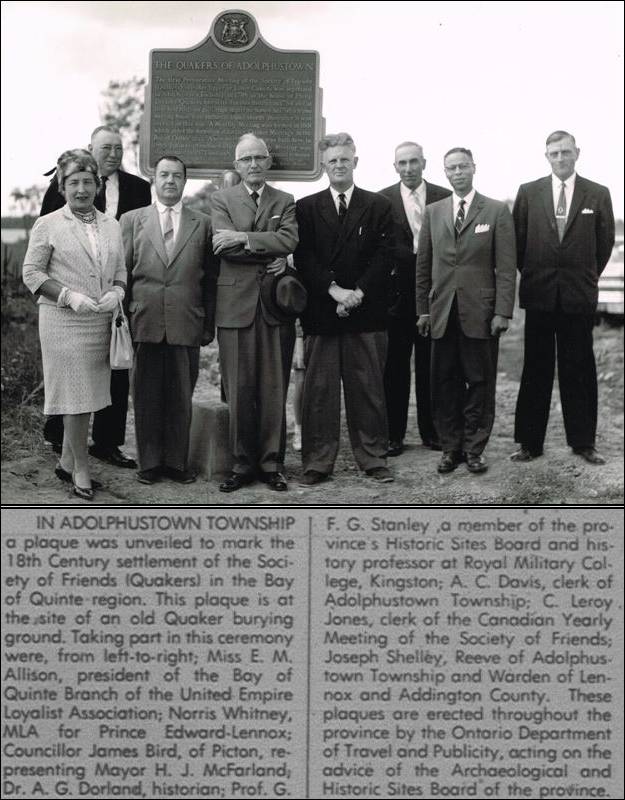
October 1962 |
|
Quaker Monument and Burying Ground as it Appears Today |
|
|
|

Further
Information: