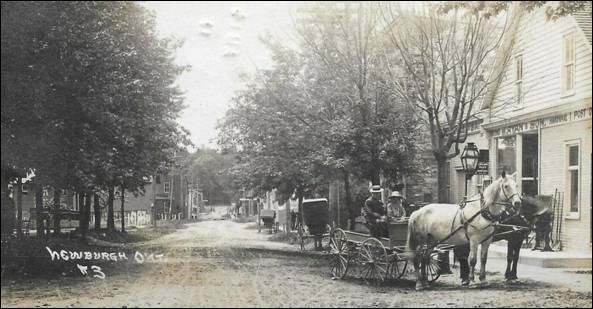
|
c1911 |
|
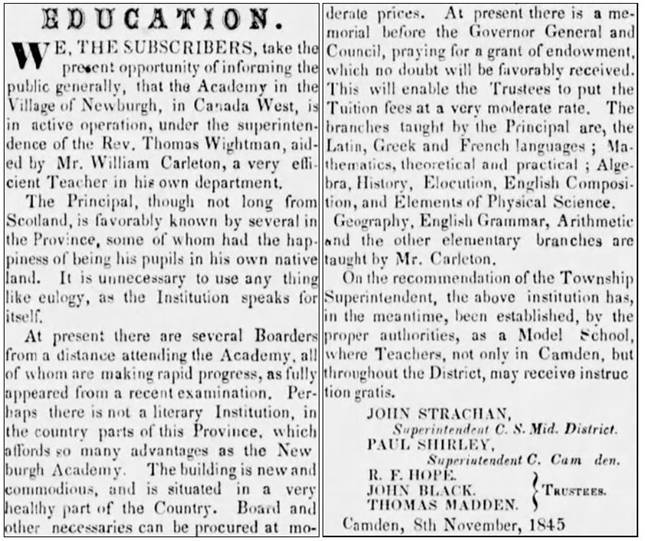
The
Newburgh Academy British
Whig and General Advertiser for Canada, Nov. 18 1845 |
|
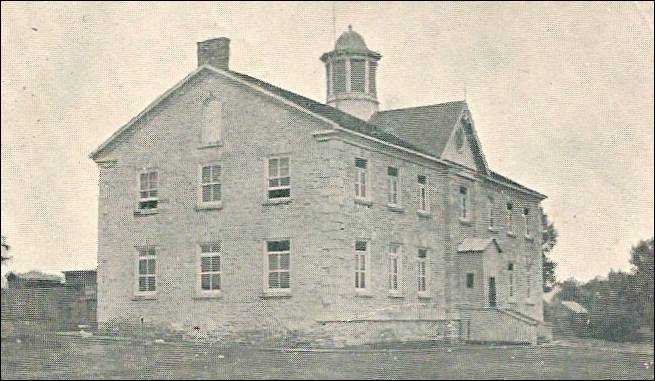
The
Newburgh Academy An Old Postcard |
|
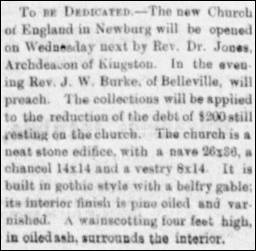
Daily British Whig Oct. 8,
1881
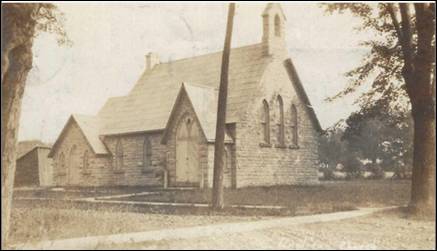
The Church of England – An Old Postcard |
|
Misc.
Clippings
|
|
Newburgh
(Excerpt) By Thomas W. Casey Newburgh was a small and very thriving and ambitious village in 1858, and judging by the number of business advertisement in the columns of the Index at that time, it must have had within its borders a considerable number of very enterprising business men, all or nearly all of whom have now passed off the stage of action. There were first the business cards of Allen Caton of “the Old Stone Shanty,” a very enterprising druggist, book seller, publisher, insurance agent and Secretary of the Board of Public Instruction for Frontenac, Lennox and Addington; to which he also added some successful farming. Mr. Caton, after a successful business career of years in Newburgh, died in that town and lies buried in the cemetery near by. Then comes the card of Allan Ruttan, M.D., Coroner for the United Counties of Frontenac, Lennox and Addington. After graduating with honors from McGill University, Montreal, the Doctor first located in Newburgh and soon obtained a good country practice. Newburgh was then ambitious to become the county town of Lennox and Addington and was the fully equal to Napanee in intelligence, population and business enterprise. The Grand Trunk railway, built a few years later, and being located through Napanee, appeared to turn the scale in the latter’s favor. The Doctor being convinced the village would never attain much more in population or importance, changed his location to Napanee, with a short interval at Picton and here the balance of his useful days was spent. John King was then a resident of Newburgh and advertised as an “auctioneer and general commission agent, Township of Camden.” He was a hotel keeper there at one time and also moved to Napanee, where he was in business here for years. Later on he received a government appointment in the customs, and lived and died at Windsor, we believe. Luke Carscallen also advertised as an auctioneer and general commission agent. He was a well known citizen of the village and lived and died there. Richard Rook, then a well known citizen, advertised as a dealer and repairer of watches, clocks and musical instruments. Lame from his childhood and dependent on a large Newfoundland dog to draw him from place to place on his small low cart, he managed to carry on a areal profitable trade and provided comfortably for himself and family. Owen S. Roblin, a native of Adolphustown advertised there was “nothing like harness,” and carried on that business for years. Later on he moved to Syracuse, N.Y., where he lived and died. The Wells Brothers, John C. and Allen C. were also in the harness, saddle and trunk business and advertised as good an article in the line of business as can be obtained for the same money. They are of the few advertisers who are yet living, - the former now in business with his son at Tamworth and the latter a large and successful farmer at Chilliwhack, British Columbia. Simon Haines was then an axe manufacturer, and advertised that business. It may as well be said here that Newburgh was once noted for its axe making and supplied a large section of the country with an excellent class of implements in that line. Mr. Haines was one of the patriotic militia volunteers during the Canadian rebellion of 1837-8, doing active service. He was at the celebrated battle at the Windmill, Prescott and witnessed the arrest of the unfortunate Von Sholts, who was hanged at Kingston, for his share in the American invasion. Mr. Haines lived and died in Newburgh. Henry Finkle then advertised his stage line, leaving Centreville every morning for Napanee, via Clark’s Mills, and connecting with the Grand Trunk here. Mr. Finkle was a successful stage owner and carriage builder and since his death the business has been well sustained by his son. Miles Caton and Cephas H. Miller were the, and for many years after, successful and well known grocers and dry goods merchants. Both died at Newburgh, highly respected men. |
|
The
Scene of the Fire How Newburgh Was
Demolished Yesterday Kingston Daily News Sept
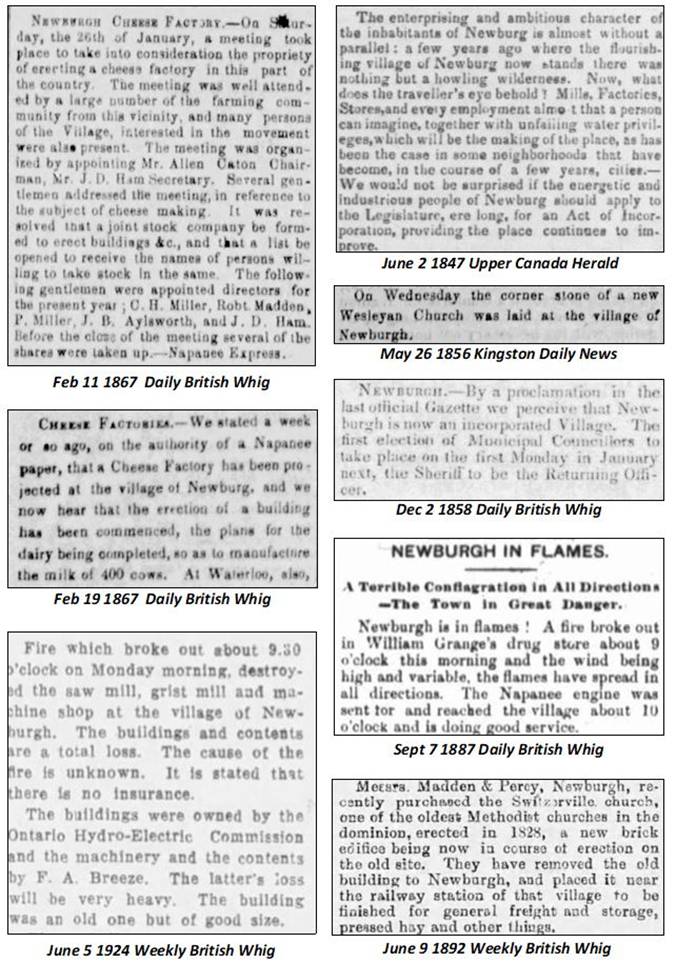
8 1887 The Scenes Which a News Reporter Witnessed – The Homeless Wandering on the Streets – Several Very Sad Cases – Help Wanted. Newburgh this morning presented a scene of desolation, the centre and business part of the village having been laid waste yesterday by fire. After word had been received in Kingston of the destruction going on, a NEWS reporter left for that place to secure all the information possible. Passing through Odessa, to the right could be seen clouds of smoke ascending heavenwards. What remains of the village was reached shortly before six o’clock and the sight that met the eye was appalling. On both sides of the main street, after crossing the bridge, nothing but burning embers could be seen. Crying women and children were scattered about in every direction. Men, half crazed by their losses, were walking listlessly about, seemingly not caring what happened. The centre of the street was warm with the intense heat which had prevailed. When the reporter arrived, the Napanee firemen were engaged in gathering their apparatus preparatory to leaving for home. When the fire first broke out, a small hand engine belonging to Newburgh was brought into requisition, but it was comparatively useless and as the flames quickly spread, the telegraph wire was brought into use, Napanee called up and a message for help sent over the wires. One hour and five minutes after the despatch was sent over the N.T. & Q. RR., a special dashed carrying the fire ladies and their engine. Newburgh people state that never were they so thankful for anything as when the help came. The visitors worked bravely and after six hours of toil and labor they were rewarded by seeing the flames stayed. The origin of the fire is attributed to small boys, who were smoking in the barn adjoining the residence of Dr. Duff and John Grange’s drug store. Mr. Grange used the upper part of the barn as a store room, while in the lower part, Dr. Duff kept his horses. The fire was first discovered shortly after 9 a.m. Dr. Duff who was in his surgery at the time, hearing a voice calling “fire, fire,” ran into the yard and found the barn in flames. With difficulty he rescued his two horses and buggies and as the flames were spreading rapidly, he notified Mrs. Duff and Miss Strange of Kingston, of the fire. Mrs. Duff hurried out, but Miss Strange remained behind to secure some articles and Dr. Duff, seeing that she was in danger rushed in after her and it was with difficulty she was rescued. Of all his furniture, only a sewing machine was saved. All his books collected from early youth, up, were destroyed, as well as his medical instruments, worth hundreds of dollars. On these and his furniture, he had no insurance, consequently his loss can be estimated. His business books were also destroyed; thus the doctor is placed in a most undesirable position. After the fire had burned for a short time, the high wind blowing at the time carried the cinders across the street and ignited the store of Thos. Johnston, which also quickly fell a prey to the devouring element. At the same time, Dr. Duff’s house being on a corner, the three houses on the other corners also caught fire and burned furiously. Back of each house the flames spread until at one time, over seventeen building were burning furiously. The residents became terribly excited and people were running hither and thither, unable to do anything. Many attempted to rush down the street and were scorched. Until the help arrived from Napanee, nothing could be done, as the heat was so intense, no person could go near the burning buildings. Men and women were helping neighbors to remove their furniture and things, when they were warned that their own places were on fire. Some people in removing their furniture, placed it at what they thought a safe distance away, but they were mistaken, as in many cases it took fire and was destroyed. After John Wells’ harness shop had ignited, R. Rooks’ jewelry store followed next. Mr. Caton’s house and store on the east side followed and then the town hall blazed up. At this time sheds and stables in rear of the places mentioned were burning furiously and the high wind carrying the cinders, set fire to W.A. Bell’s barn, two miles away and burned the building with all its contents. Jas. Davy, shoemaker, besides losing everything he owned, was badly burned. He was assisting his neighbors to remove their things when he was notified that his own house was in flames. He entered what was then his home, and which was fast disappearing. Seeing that he could not save any of this stock or furniture, he descended to the cellar after two bales of leather, but there the smoke choked him and friends hearing his wife scream, he was pulled out of the burning building with much difficulty. His arms, neck and face were badly burned, and Dr. Duff had to turn his attention to him. His injuries were dressed in the best manner possible, all the doctor’s drugs having been destroyed. Just as darkness was settling down as the wind was getting fresh, the NEWS reporter, with his overcoat buttoned tightly around him, took a walk through the village and a sorrowful spectacle met his sight. Husbands and wives, with their families gathered around them, stood looking at all that is left of their homes. Some were lamenting their misfortune, while others could not realize their positions, every thing seeming to them like a dream. Among the most unfortunate were James Davy and his wife. His arms and neck were swathed in bandages and as he stood gazing on the ruins, he remarked: “Last night I saw worth $3,500 or $4,000; tonight, I have not a cent. His wife burst into tears. Everything they owned in the world had been swept away in an instant, as it were. The coat which was wrapped around Mr. Davy’s shoulders, was borrowed, while Mrs. Davy was hatless, all their clothing having been destroyed. The old gentleman stood muttering to himself as he looked at the site of his old home and tears rolled down his cheeks. He was asked where he would stop and he said: “Don’t know.” A kind hearted villager, who had not been burnt out, then came up and asked the old couple to make his home their resting place, till they secured another home. His offer was accepted and the old man and his wife moved away. This is only one instance of the many sorrowful sights which were witnessed. Here and there burning embers yet flickered and cast a weird look over the desolated place. Walls of stone buildings that remained loomed up as monuments of the disaster, while flickering lights gave instantaneous glimpses of hundreds of people gathered in knots here and there on the field of ashes. The sight was one never to be forgotten. Barefooted and homeless little children were frequently met. Mr. John Burdett was interviewed and he estimated his loss at over $10,000. On his property which was destroyed, he had no insurance. He is not discouraged. He will remain in the village and at once start to build again. He believes that it will be years before the place will again be as prosperous as it was. Mr. Burdett was the only villager, of a large number who were spoken to, who had decided as to what they will do. The only hotel in the place is in ashes and there is no place for a traveller to stop. Last night not a pound of butter could be secured, or a loaf of bread for love or money. Every store is in ashes and the stocks were consumed. Many who had no place to go last night slept where they could lay their heads. When the word was passed around that the post office was on fire there was a great rush to secure letters and later when the telegraph office began to disappear, residents say that a feeling of utter loneliness crept over them, as they felt as if everything connecting them with the outside world was disappearing; as if the last link connecting them with friends was being severed. Mr. John C. Wells in attempting to save some articles of furniture had his legs and body severely burned. His injuries are painful, but not dangerous. One disgraceful feature of the disaster was, that some parties indulged in thieving to a considerable extent, carrying off boldly what they could lay their hands on. This morning a meeting was to be held of the sufferers when something would be decided upon to assist those who are in want. By giving a description of the place, those who have been in Newburgh can understand the devastation. After passing over the bridge and by the paper mill, every place on both sides of the main street with the exception of about a dozen buildings are destroyed. From the town hall, back to the N.T. & Q RR station every stick of wood, small shed or building was swept away. A large quantity of lumber owned by the Rathbun Co., burned like match wood. Dr. Duff’s residence and John Grange’s drug store, took fire simultaneously. These were followed by Wells’ harness shop and the billiard room. Then A. Caton’s store ignited and the roar of the flames was awful. While Caton’s store was burning, the town hall, owned by Mr. J. Burdett, ignited, and from that moment, houses all over the village were set on fire and confusion reigned. When a house caught fire, the owner had to remain idle in many cases and watch his property disappear, as the Napanee engine was working where it would do the most good. The woods surrounding Newburgh which caught fire, burnt only for a few hours and at ten o’clock last evening they had been extinguished. Many of those whose home were destroyed went to Napanee on the train while others went to Clark’s Mills. Hope’s Hotel is a thing of the past and the reporter was very glad to be able to feast on rye bread and half cooked potatoes. The peddler with butter, meat and provisions who would pass through the burned village today would sell goods like hot cakes. The roof of the paper mill was saturated with water to keep it from igniting. A correct list of the places burned is as follows; Jas. Davey, shoemaker; W. Sutton, butcher; C. Sturm, groceries; Hopper & Paul, general store; Chas. Thompson, residence; J. Lamfield, harness shop; Telegraph Office, C.P.R.; J.C. Wells, harness shop; D.A. Burdett, residence and machine shops; Ed. Knight, grocer; Miles Caton, dry goods and hardware; Thos. Johnston, dry goods; W. Grahame, drugs; R. Roake, jewelry; T. Lovell’s, tailoring; C. Sterman, grocer; H. Paul, dry goods; Douglass & Hooper, Post Office and dry goods; C. Welbanks, grocery; Chas. Stone, grocery; billiard and pool room; Robert R. Hope, Hope Hotel; W. Sutton’s house occupied by A. Knight; the Salvation Army barracks; W. Aikens, dwelling; Finkle’s blacksmithing shop; J. Farrelly’s three machine shops; D. Hooper’s barns; J. Taylor’s barns; W. McLennan, house shed and barns; C. Frey’s house and barns; Rathbun’s sheds, filled with lumber. Station agent’s house of the N.T. & Q RR; Henry Finkle’s house occupied by Miss Finkle; dwelling house and sheds of M. Ryan; house occupied by Mr. Watts; residence, sheds and barns of Chas. Hill; Rathbun’s coal sheds; residence of Mr. Soles; residence of E.O. Lanfear; residence of Ezekiel McConville and several others. In the matter of insurance, none, as far as could be learned, were insured. The Rathbun company and the T.T. & Q. RR may have policies. The total loss it is impossible to yet estimate. One thing certain, it will be some time yet before the village is again as prosperous. When Newburgh was left at eight o’clock, watchmen had been posted around the village to prevent another fire occurring. At that hour the sky was clouded and there was intense darkness. As the hill was ascended and the desolate place looked upon, it seemed as a common covered with small bonfires. The scene was a peculiar one and suggested a camp of soldiers with signal fires lit.
|
|
Newburgh
As It Is Considerable
Transformation Since the Fire Nearly a Year Ago British Whig Aug 17 1888 Newburgh has vastly improved since the disastrous fire attacked it last fall and is now rebuilt in a handsome way. It was with interest that we noted the changes made. Thomas Beck has erected a commodious hotel, well equipped and having all the necessary stable and shed accommodations. D.A. Burdette has built two nicely finished houses on Concession street, which are rented. Mr. Courtice is building a veneered brick residence of neat design. Near to it, George Thompson has completed a $4,000 brick house. It stands in the centre of a beautiful lawn. William Sutton utilized part of the old walls, adding a new front of brick, thus giving him a commodious residence and store. He has also built a fine barn. A. Fox and R. Dugan are finishing nice homes and W. Taylor is building one for himself. Mrs. Rook has vastly improved her property and her new house looks decidedly tasty. Messrs. D.B. Stickney, W. Miles, Loucks, Presley, Farley, J. Remo, C. Shorey, L. Fox, H. Dunn, M.W. Simpkins and R. Paul have made most pleasing improvements to their residences and premises. Henry Dunn has built a good brick blacksmith shop. Mrs. Deroche has fixed up her estate and the Methodist parsonage has been thoroughly overhauled. On the west side of Main street, Dr. Duff has built a fine brick house, while the Masonic hall and drug store make a most attractive block. Henry Paul has added a commodious store and house and E.O. Lanfear’s fine home is really an ornament to the place. Mr. McConnell has rebuilt his stone residence and has added a new barn. The blocks occupied by C.W. Welbanks, H. Finkle, Caton and Woods are such buildings as reflect credit on the enterprise of the villagers. R.B. Hope has completed his new hotel and a really fine structure it is. Mr. Farley has rebuilt his shop and has added a fine veneered cottage and new barn. C.W. Thompson’s residence, costing $6,000 is approaching completion and is the finest residence in the village. It stands in a commanding position. Joseph Taylor has moved into his new factory. The new station of the N.T. & Q. RR. Is number one in every respect. C. Hill has finished a very pretty cottage, while Mr. Fry has put up a commodious residence on the old site. It was the first building completed after the fire. Other slight improvements have been made to buildings and properties, altogether making Newburgh a pleasant place to visit. Some sixty-six new buildings have been erected since the fire of September last. |
|
Village
of Newburgh Sketch of the Town – It
has Gone Ahead Recently Daily British Whig June 2
1891 The village of Newburgh, in the county of Addington, is pleasantly situated on the Napanee river and at one time was a very flourishing village. On 7th Sept., 1878, the business portion of the village was swept out of existence and dissolved into organic gases, leaving an unsightly residuum in the shape of ruined walls and charred timbers, to indicated where eighty seven places of business had once catered to the diverse wants of the agricultural and industrial communities that lived within and without the village borders. An advance in insurance rates, due to the lack of fire protection, provided by the village fathers, had occasioned a feeling against the different companies doing business in Newburgh and the villagers, lulled into a false sense of their security, had refused to renew their expired policies. The consequences of their folly was realized by many who saw the hard accumulations of years swept out of their possession in a few moments. But Newburgh possessed some inhabitants who were worthy descendants of the men who had made their homes in the wilderness and although the growth of the village has not been rapid during the past thirteen years, the substantial character of the new buildings lend a promising outlook to the future of Newburgh. The principal industry of Newburgh is paper making, the mills of Jas. Thompson & Sons and the Napanee Paper Co. furnishing employment to a large staff of employees. Hilton Finkle carries on a large carriage factory and turns out a varied line of all sorts of wagons, carriages and carts. His father, the late Henry Finkle, established the factory over forty years ago and the reputation gained by the founder has been well sustained by his son. Wm. McKim owns a carriage factory in the village and has the reputation of doing good work. Stigney’s foundry and machine shop has more than a local reputation for mill graining, mowers, reapers, ploughs, stores, &c. The largest cheese factory in the county is situated in the village and is owned and managed by E.J. Madden, the cheese king of this Midland district. J.W. Courtenay is the proprietor of the village tannery and from the success he achieves in the business, the public are led to believe in the wisdom of the old saw, “there’s nothing like leather.” John Drury is the proprietor of the roller mill and does a general custom business for the neighboring farmers. Charles Welbanks is the village tinsmith, manufactures milk cans, dairy utensils and sap buckets extensively, the surrounding country being well provided with handsome maple groves reserved for sugar making. M.W. Simkins has made his name famous in the counties as the sewing machine man, having made a specialty of that useful domestic article for years. Henry Paul has a general store where every want can be supplied. L.W. Percy bids for public patronage in the same line. Dr. Duff, as owner of the village drug store, does a good business in dispensing his own prescriptions. Robert Hope, the genial Boniface, presides over Hope’s hotel and conducts it in the same homelike manner that gained the old hostelry such celebrity under his late father’s management. Among the new buildings in Newburgh, the homes of Messrs. Charles and George Thomson and H. Finkle would be considered an ornament in any city. The following new buildings have been erected since the fire on the site of the old ruins: R. Hope, hotel; Charles Thompson, residence; Harvey Wood, harness shop and residence; Wm. Sutton, grocery and residence; J. McEvoy, hotel, H. Finkle, hall and showroom; Masonic hall and store; Dr. Duff, Residence; Henry Paul, store and residence; Mrs. McConnell, residence; E. O. Lamphear, residence; D. Burdette, two dwellings; J.W. Courtenay, residence; D. Hooper, dwelling; M.W. Simkins, residence; Jas Taylor, axe factory and residence; Jno. Farley, M. Fry, M. Ryan, Chas. Hill, residences. The village contains three churches, Church of England, Presbyterian and Methodist, the last named being surmounted with one of the most elegant and proportionate spires in the province. The old Newburgh academy has been the training ground of many worthy Canadians and still maintains her prestige as an alma mater. The fair grounds are pleasantly situated on the hill top, south of the village and many lively contests in athletics take place therein. We cannot close our sketch of Newburgh without mentioning the names of James Fullerton, who can fit out a house with the best productions of the cabinet maker’s art and W.H. Aiken, who is always pleased to render his services as undertaker as solemnly as the occasion requires. Many years ago a squatter built a log shanty on ground that is now the centre of the village. Breaking a bottle of whiskey over the top log when raised he declared it was the “pride of Rogue’s Hollow,” and Rogue’s Hollow the village was called for many a year.
|
|
Newburgh Industries “Rogue’s
Hollow” of Years Ago Has Grown to be a Thriving Village Kingston
Daily News Nov 3 1891 Many years ago, when this pleasantly situated burgh, which so pleasantly
nestles between the hills, was yet in its ‘teens, it was known only as
“Rogue’s Hollow.” Of course that name was an awkward misfit to the character
of the people of that day, and particularly so to their descendants of the present day –
as great a misfit as that in the case of our acquaintance, Mr. John Shortt, who stands six feet four in his shoes, or of one
Jeremiah long, who stands four feet six in his. Years after, when churches
and temperance societies began to live and spread, the neighbors compromised
matters by calling it “The Holler,” for short. I took years and years to get
it recognized as Newburgh. The village was a thriving and ambitious one in those days. The water
did not all run out of the Napanee river then in the summer, as it just now
has and there were busy mills and factories and works, such as there nowhere else existed on the stream, but many of
these have long since gone. It has had its three newspapers, though they all
passed through single file and they are gone. It had its expectation of
becoming the county town, when Lennox and Addington would be separated from
Frontenac, but that has long since gone too. It had its railway charter for a
road to connect with Kingston at the one end and some distant bay or harbor
at the other, but that was forty years ago. Now the Napanee & Tamworth
runs through it, but seems to have done most of its business men more harm
than good. Its last and most serious misfortune, however, was the great fire
of Sept. 7th, 1887, which nearly wiped the town out of existence. Newburgh, however, has revived more tangibly from that great fire than
many expected it ever would. A large number of fine dwellings and shops have
been built since and more are now in course of erection. Its present
manufacturers and business men seem busy and prosperous and stand well to the
interests of the place. The largest of the manufacturing interests here now is the paper mill
of the Napanee Paper Company. The mill was built years ago and was the
pioneer of its class on the Napanee river. It has had several changes of
proprietors since but has always been kept actively at work. It now turns out
about two tons of printing paper a day, such as the NEWS is printed on. It
gives steady and remunerative employment to a large number of hands. Its
proprietors live in Napanee. The Messrs. Thompson, who were of the original company building this
mill, still remain in the village and have since erected large mills of their
own two or three miles farther up stream, of which more
will be said in the future. Mr. James Thompson is now Reeve of the village
and he and his three sons are pushing business men and important factors in
the future success of the place. John Farley is probably the oldest active business resident of the
place. He has been at work here since 1844 and has been “the village
blacksmith,” or one of the, ever since. Farley & Son combine waggon and
carriage making with their other business and are always busy. Their home all
went up in flames and nearly all their life’s earnings, at the great fire,
but they are will built up again. D.B. Stickney has been forty-five years in active business here with
an iron foundry and agricultural implement, machine shop and gives good
promise for years to come. His establishment is the most extensive of the
kind in Addington county and gives employment to a number of workmen. Mr. Finkle carries on more extensive carriage works than anyone else
in the united counties and they are of the very finest and neatest class.
From 12 to 15 hands are at work with the aid of improved machinery. Just now
about 75 cutters are being finished in readiness for the first sleighing. A
little below this Mr. McKim has also a fine establishment from which a large
number of beautiful carriages and sleighs have been sent out to various parts
of the country. He has a well-established reputation in his line of business. Mr. J.W. Courtney is doing a large and profitable business in tanning,
making a specialty of pebbled leather, fancy morocco and the dressing of furs
and skins. His fine sleigh robes and mats are very much admired everywhere
and well deserve high praise. Mr. Harvey Wood is doing a capital business in
making leather into harness and in fine carriage trimming. He was a very
successful exhibitor at the county fairs of both counties this year, besides
the township fair. He has recently finished a fine brick residence and shop
on Main street. Mr. Fullerton is still actively engaged in the manufacture and sale of
furniture. His father established a good business here many years ago and its
reputation is till well maintained. Mr. Eakins was badly destroyed at the
great fire, but is still in the furniture and undertaking business. The flour
mills which were long established here are now in the hands of Mr. Drewry, a
practical machinist, who has put in a capital set of rollers, capable
of the best first-class work. Mr. R. Paul carries on the door and blind
factory and house-building establishment formerly run by the late Edward
Jones. The Hooper mills, once well known, both for flour, oat meal and
woolens, are now closed. The Newburgh cheese factory was one of the very first established in
the country. It is now owned by Mr. E.J. Madden, well known in Kingston and
all the surrounding counties as an extensive cheese buyer. The factory still
is well at the head of the procession, both as regards the quantity and
quality of cheese made. Everybody within a radius of many miles is familiar with the genial
face of Mr. Simpkins, the noted sewing and knitting machine man. He need
hardly be spoken of; he speaks for himself in nearly every household –
especially where a machine is needed. He is doing well his share in building
up the town, having erected several neat buildings since the fire. The “old
stone shanty,” as the late Allen Caton was so fond of calling his former drug
establishment is just being rebuilt by M. Finkle and will present a finer
appearance than before. The lower storey is being finished into a general
store for Mr. L.E. Percy and the Mechanics Institute and the upper flat into
a large public hall for general purposes. Mr. Percy, who is now a well known
merchant here, as purchased the Russell property on Main street and is
fitting it up finely for a residence. Dr. Duff and Mr. T.A. Dunwoody have a large and neat drug store, in a
new building and seem to be doing a fine trade. It was in these premises that
the great fire had its origin. It is said that a stable boy indulging in a
smoke was at the bottom of the whole trouble. Newburgh is a church-going town. There are three good churches –
Methodist, Presbyterian and Anglican, besides the Salvation Army and all have
very respectable congregations and very large, too, considering the
population. The Newburgh academy was the pride and glory of the place forty years
ago and it is still well sustained. Few small villages have showed so much
spirit in providing educational advantages and the good results are apparent
in the prominent position that many of its “boys” now occupy all over Canada.
It was there that Judge Price, Rev. Dr. Manley Benson, W.R. Aylsworth, C.E.,
A.B. Aylsworth, Q.C. and many prominent bald-heads and grey-beards of today
were drilled and thrashed and schooled. The educational work in the same
walls is now as complete and official and possibly the scholars of today are
destined to occupy equally important and honorable positions in the time to
come. |