|
Note: Photos have
been added and do not appear in the original article. Special Correspondence of the
Inquirer, DeFoe House Belleville, Ont., Can., August
6 1884 Halting at the Windsor Hotel, a newly-built house in Kingston, I spent
two days in visiting this quaint old capital, whose population now reaches 10,000.
The outlook from the city, which occupies a gentle slope on the northern
shore of Lake Ontario, is one of the most beautiful in the world. The roads,
laid on the solid limestone rock, on which Kingston is built, are singularly
smooth, the result of convict labor. The driving is fine; from the number of
handsome faces seen, it is plain that the civilization is old and a stay of
some weeks here, long enough to form acquaintances, must indeed be pleasant.
19th
Century Kingston Some of the dwellings, most of which are of gray limestone, are
palatial in appearance. All are artistic, though but few are of more than two
stories. The grounds surrounding them are large, redolent with flowers and
the streets, whose sidewalks are of boards, are overhung with long lines of
elm and sugar maple. In traversing King Street, the principal thoroughfare,
we catch beautiful glimpses of the great sea of Ontario and at the upper end
of the city are some governmental grounds, down in grass, on which we
sauntered in the evening to gaze across the green waters, watch the sails and
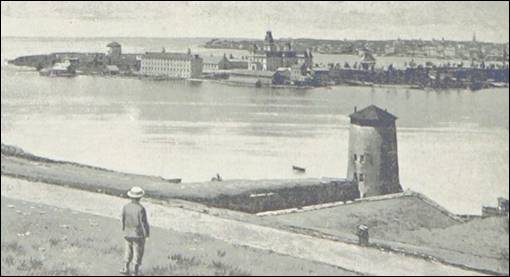
listen to the roar of the waves that at this point break upon a rocky coast. At the lower end of the city is Cataraqui Bay, long, broad and deep,
beyond which lies a long, rolling peninsula on which is built Fort Henry, and
at the foot of this is seen the Royal Military College, surmounted with
Norman towers, known as the West Point
of Canada. Not every lad is rich enough to attend this institution! Besides
this and the numerous churches here, none of which are large, though all
artistic, the principal public buildings are the asylum, the penitentiary and
the Queen’s University, the latter occupying a high position in the western
end of the city overlooking the public park, not large, but attractive as a
place of resort. In one part of the town, while we rested here in the
evening, the Salvation Army preached and sang to the people; in another the
Military Band at old Fort Frontenac discoursed sweetest music, while the
young ladies danced with the cadets or were rowed about with them in their
gondolas on Lake Ontario. The greatest public work is the military canal known as the Rideau,
that connects the Ottawa with Lake Ontario. Much shipping is seen in the
spacious harbor; all steamers traversing the lakes touch at this point and by
way of Kingston Mills, where there are large elevators, a great deal of grain
from the West is shipped directly to Europe, instead of passing to New York
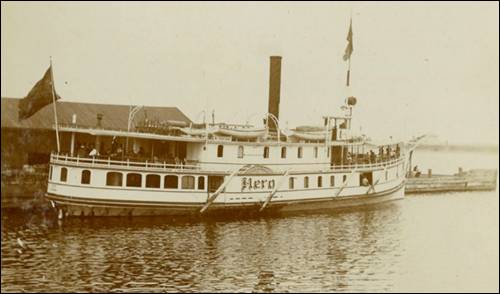
by way of the Erie canal. On leaving Kingston, which we did with regret, we embarked at two
o’clock P.M. on the swift going steamer, Hero, to explore the far-famous Bay
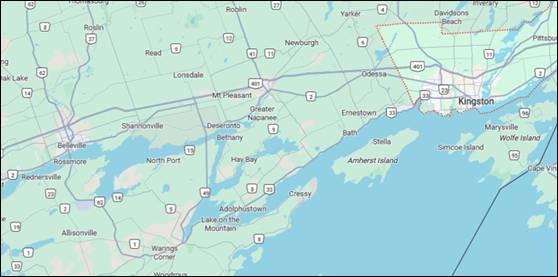
of Quinte, a sheet of water eighty miles long, running from Kingston
northwestwardly toward Toronto and terminating just beyond Belleville, where
we landed, at the town of Trent. It is a pity that so little is known by
tourists of this beautiful trip, not surpassed by that up the Hudson, of the
Thousand Islands or of the rapids of the mighty St. Lawrence. The Canadian
Government, however, is cutting a ship canal across the peninsula of Prince
Edward, so that ships in bad weather, in going from Niagara, Toronto and the
great lakes of the Northwest, can make the run to Kingston at the head of
Lake Ontario, for the most part in still water. This, then, will become a
favorite excursion route and the shores of the Bay of Quinte will be lined
with summer cottages and its waters constantly traversed by steamers and
canoes. This was an old Indian highway; Champlain, in returning from his trip
up the Ottawa in 1615, passed down it, to be lost in the woods on the way
while chasing a speckled woodpecker and the trip was perhaps enhanced in
interest to us by these reflections. The Hero, sometimes called the greyhound of the lake, is a clean,
swift going boat, adapted to these waters. For a while after leaving the
wharf we were in sight of Kingston, on the right, with its charming grounds
and gardens, while before us on the south, some miles off, lay the great Wolf
Island, crowned with verdure. Between this and Amherst Island, in sight on the
left is a gap, five miles long, through which the winds sweep down from lake
Ontario and throughout this part of the journey, as there had just been a
shower, though the sun was now shining, the wind blew fiercely and as the
little steamer climbed and descended the long, rolling waves for the space of
half an hour, all experienced a short sea sickness, affording for some days
the staple of conversation.
The
Steamer “Hero” Once past this gap the true trip up the Bay of Quinte, whose shores
gradually contract, but as gradually rise in height, really begins and the
excursion to Belleville seems indeed as a dream. People seek the bow of the
boat, gain the pilot house and pass to and fro on the deck seeking to get a
fairer view. The atmosphere, although it is late in July, is so cool that all
wear wraps and fall overcoats and weariness, as a consequence of travel, is
unknown. The steeples and Norman towers and forests of masts at Kingston on
the right gradually fade from view. Then come charming villas, beautiful
grounds and clumps of shade trees and then for miles a gentle slope back to
hills crowned with wood and blue as the heavens. Throughout the whole of this
space are apple orchards, small herds of cattle and prairie-like fields, down
in grass of the deepest green closely shorn. And thus on the right it
continues till we gain the little Dutch town of Bath. On the left we have for nine miles been running past Amherst Island
and being closer to it than the main land on the right, notice that the
Island’s substructure is a layer of shelving rock; that the dwellings, mostly
of one story, are neat in appearance; that there are large green fields of
wheat and barley waving in the wind and that the trees are, for the most
part, maple, elm and arbor vitae, the latter fringing the streams and rocky
edges of the bay on the right above Bath, at which the steamer touches for a
moment; the shores gradually grow bluffy and rolling. In the distance is seen
a long blue line of trees and the intervening space, which is somewhat
broken, is perhaps one of the finest farming districts ever seen. The fields
are large, well tilled, rolling with wheat and barley like the waves of the
sea; the trees are maple, arbor vitae and pine and at [Fredericksburgh] we
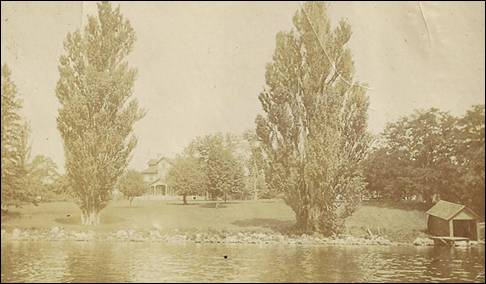
behold a palatial residence, in which for a time during the summer, resides
Mr. Neilson, one of the managers of the Northern Division of the Pennsylvania
Railroad. Nor go where he may, will his eyes ever rest upon a fairer farming
country. It is indeed what the French call the wish of the eye. The Bay of
Quinte Barley is famous all over the world. As we sail along we dream of Ruth
and Boaz and the gleaners and the threshing floor.
Neilson
Residence at Conway, South Fredericksburgh At the end of Amherst Island the bell rings for supper. In this
October air we do it full justice and I record it here, in praise of those
that love the right and for the benefit of other tourists, it was ample,
clean and good. As we rose from supper, on the left, there came forth to
sight, Indian Point, a promontory of Prince Edward County, not unjustly
called the garden of Canada. The shore, still of shelving rock, is growing
bolder. The fields team with wheat and barley, as yet uncut and there are
here many fine apple orchards, one of which, called Cressy’s
has ten thousand trees. They were green, low, branchy, well-kept and laden
with delicious fruit. As we near Adolphustown on the right, at which we touch, the ground is
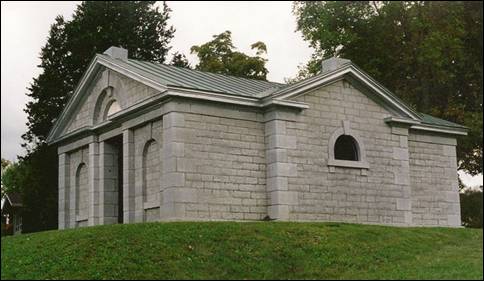
more rolling; if possible, the scenery more beautiful. At Allison’s Point on
the way we pass a large cross-shaped mausoleum, built of gray limestone. Nor
could Mausolus himself, though King of Caria, have
found a cooler place in which to sleep his last sleep. The dwelling of the
owner is of brick, imposing and it occupies a romantic site overlooking the
bay. Just below and above the village of Adolphustown, the river is strewn
with little fir-clad islands, amid which are people floating round in their
tiny boats, singing song. They wave their handkerchiefs at us, we at them and
then part, wondering if we shall meet again.
The
Allison Mausoleum at Adolphustown On the left, however, the scene is simply enchanting. The farms are
fine; at every mile or two there rises a small red brick church, with tiny
steeple, built by the Wesleyan Methodists; and, in the distance, towards
which we press, are seen the high, bluffy and fir-crowned shores of Glenora,
up whose sides run sloping graded roads to the top of the great bluff, on
which, near some cottages, is a lake, perhaps two miles long and as yet
unfathomed. Its waters, far above the level of Lake Ontario, are supposed to
be supplied by a subterranean passage from Lake Erie. At the foot of the
bluff is a semi-circular depression of ground, planted with apple trees; and
here, by the bay, is a large stone mill, at which the steamer touches to take
in passengers. We fancied that nothing could be finer than the trip thus far and yet
a fairer scene awaited us. The Hero bent her course southwestward into the
very heart of the peninsula of Prince Edward. The shores are high and fringed
with birch, maple and fir, while the broad bay was as smooth as glass. A few
miles further on, the bay contracts almost closes. But, just as we fancied we
had reached its rounded upper end, we saw in the bank an opening through which the hero passed; a
bay spread out in front of us shaped like a wagon spring, of perhaps two miles
long, over hung with woody shores. In a little while we would surely be at
the end. But looking from the prow of the Hero, we say, through an opening
where the bay should have ended (as if the curtain of a theatre had lifted
up), a large two-masted ship. We pressed on, passed through this gap and were
traversing another tiny bay, of elliptical shape, at whose head, embowered in
groves of fir and maple, was descried the little
city of Picton. All on board the Hero were loud in their praise of the
romantic scene. The bay was as clear as crystal and unruffled by the wind;.
On the right were tasty brick cottages, amid the trees. On the left was a
miniature of Warwick Castle, in stone, with Norman towers and turrets, amid
the most beautiful grounds, just at the entrance of the bay. A little further
up was seen the residence of Lawyer Low, with its domes, spires and minarets,
reminding one of the fairer Parphar. The little bay
itself swarmed with rowing and singing gladdening songs, who greeted us with
the waving of handkerchiefs. Few, indeed have ever seen such a scene of
beauty as this. There is nothing at the Thousand Islands that equals it.
Ulysses must have passed some such place as this when he heard the sirens
singing: “Come ye, come ye, great captain, come unto our green-clad shores
and rest.” Another destiny, however, awaits us: good or worse, who can tell? The
little steamer swings round at the wharf, makes for the Long Reach or narrow
strip of water running northeastward, perhaps twenty miles long by one wide, girted by high, bluffy shores,
green with forests of fir. Through this strait we ride for some time. Night
settles down upon us, though the scene is still attractive, the moon pouring
a flood of silvery light on the placid waters. At ten o’clock, we have gained
upon the right, the little town of Deseronto. The Hero touched here a moment
to disembark some passengers, swung round toward the west and following the
bay, which now becomes broader, but whose shores were less distinctly seen,
brought up at the fair young city of Belleville for the night, where we
disembarked. I did not intend to write so long a letter, but this sheet of
water deserves to be seen and a shorter letter seems impossible. If any man
would know more of this locality, let him read Mrs. Moody’s charming account
of her trip from Belleville to Niagara Falls. This is the next best thing to
traversing the Bay of Quinte itself.
VAN Z.
|