Click on the links
in the left column for more information on individual schools.
|
Conway |
Earliest confirmed date: 1817 Last building erected 1909. Closed 1966. |
Hwy
33 west of Conway. Building
has been demolished. |
|
|
Sandhurst |
Earliest confirmed date: 1817 |
Hwy
33 at Sandhurst Now
a private residence. |
|
|
Elm
Beach |
Shown on 1860 map. Last building erected 1873. Closed 1943. |
Hwy
33 Still
standing, privately owned |
|
|
Parma |
Shown on 1860 map. Closed 1958. |
County
Road 8. Building
has been moved to another property. Now
used as a garage. |
|
|
Sillsville |
Earliest confirmed date: 1845 Closed 1964 |
County
Road 8. Building
has been moved to another property, Now
used as Machine Shed. |
|
|
Hamburgh/Hawley |
Earliest confirmed date: 1859. Burned/Closed 1964. |
Burned
down in 1964 |
|
|
Hayburn |
Earliest confirmed date: 1842. Closed 1947. |
South
Shore Hay Bay Road. Now
a private residence. |
|
|
School Section #8 [original] |
[not named, located on C3 Add., Lot 12] |
Earliest confirmed date: 1842. |
No
remaining building. |
|
School Section #8 [Union] |
Union
[with Ernestown] |
[unconfirmed dates] |
County
Road #22 in Ernestown Township. Now
a private residence. |
|
Sandhurst Public
School |
Sandhurst |
Built
as a two-room school in 1958 and later extended. Closed 2011. |
Highway
33. Now
privately owned. |
|
Early Records from Fredericksburgh Township Up to 1857 It was not until 1857 that Fredericksburgh Township,
or Third Town, was split into two separate townships; North Fredericksburgh
and South Fredericksburgh. This section includes information for the period up
to 1857 (before the split.) |
|
It has been recorded that a Mr. Jonathan Clarke
taught a school in Fredericksburgh in 1786, but stayed in the area for only
two years. This school may have been located on the south shore of the
Napanee River, in an area later known as “Clarkesville.” If so, it would be
one of the earliest schools opened in Ontario. There are also reports of a school on Hay
Bay, run by a Mr. McDougall. If so, this could have been in either
Fredericksburgh or Adolphustown. Schools Established in Fredericksburgh Before 1816 -6 1817 -2 1818 -2 1819 -1 1820 -1 1822 -1 1824 -1 1825 -1 1830 -1 1831 -1 1837 -1 1841 -1 1845 -1 1822 William Campbell began teaching in
Fredericksburgh in 1822 [exact
school section unknown] Teacher: William Campbell, W. Methodist, b.
Ireland, Residence Marysburgh, discontinued
teaching due to age & Infirmity, age 71 in 1856 Taught
in U.C. 30 years. Commenced in Ireland
in 1809 and in Fredericksburgh U.C. in 1822 Taught 30 years and ceased 1856. Superannuated Common School
Teacher in Upper Canada for 1855 1830 Walter Hick began teaching in
Fredericksburgh in 1830 [exact school section unknown] Teacher: Walter
Hick, Church of England, b. England, Residence Richmond, discontinued teaching due to age & blindness,
age 68 in 1856. Commenced in Fredericksburgh in 1830 and taught in
U.C. ever since. Superannuated Common School
Teacher in Upper Canada for 1855 1842 Report of the Standing Committee on Common Schools,
Adopted by the District Council of the Midland District, at the May Session,
1842: That the report and estimates of erecting certain
school houses in Fredericksburgh, be accepted and we recommend that the
following sums be assessed on the
respective inhabitants accordingly, subject to the conditions mentioned in
clause No. 19 of this report: _ School District No. 1 £10; No. 2 £7; No. 6,
£50; No. 8, £47 10; No. 9 £50; No. 10, £50; No. 12, £42 10; No. 13. £50; No.
15, £45. Upper Canada Herald July 26
1842 1844 Reminiscences of W.R. Bigg “My next certificate in 1844 was from the School Superintendent
of the ‘Midland District’ and covered his ‘School Circuit’ and was obtained
without any examination whatever. I was teaching in Fredericksburgh, without
any license beyond the request of the Trustees to await the advent of the
School Superintendent, who was shortly expected and then he could examine me.
After visiting my School and inspecting the state of the different classes,
the Superintendent decided that it was unnecessary to examine me, remarking
that the status of the pupils, coupled with the very favorable report which
he had received from the Trustees, was sufficient evidence of my
qualification and he handed me the usual legal certificate. 1850 Report of the Minister
of Education In Fredericksburgh, there are 16 schoolhouses; 14
frame and two log. 4 – 18 x 24; 2 – 18 x 26; 1- 20 x 20; 2 – 20 x 22; 1 –
24 x 24; 1 – 24 x 26; 4 - 24 x 30. 7 in good repair; 9 in bad repair. 6 suitably furnished with desks etc. 1 furnished with privies 1 erected during the year Number of large maps hung up – 19 Number in which blackboards are used – 13 Number of children between the ages of 5
& 16 – 1,003 Number of children of all ages on the
roll – 691 Number of Indigent or non-paying pupils –
48 Total Number of Pupils – 691 (367 boys,
324 girls) Average Attendance in Winter – 387 Pupils
(Boys – 207 Girls – 180) Average Attendance in Summer - 423 Pupils
(Boys – 259 Girls – 164) Teachers - 21 Total – (13 Male, 8 Female)
2 Male, 2 Female trained at Normal School 1850 Fredericksburgh Report Edwin Mallory, Esq., Fredericksburgh: “The School Act of 1849 having been found so
complicated and inoperative, several of the schools were closed and the
people became almost indifferent to education; but I am happy to add that the
new School Law has given a fresh impetus to the people of this locality and
some of the sections have already availed themselves of the noble provision
made therein for establishing Free Schools.
May the friends of literature and education never rest satisfied until
Free Schools are established throughout the length and breadth of Canada.” 1852
Fredericksburgh Report The Reverend John G. Bull,
Fredericksburgh: “I am happy to have it to state that the
schools in this township are somewhat improved. There seems to be something
of a spirit manifested on the subject of education. Our schools have all been
in operation some part of the year; but our school system, notwithstanding
the improvements that have been made for the last few years is not complete,
nor will be so until we have free schools. We must have them before we shall
be able to accomplish the end contemplated. There are persons who will oppose
every thing not in accordance with their own
sentiments, regardless of consequences; and hence the present system leaves
room for much contention in various sections on the subject of taxation. Let
the government tax and all will be right. I hope our present House of
Assembly will take the subject into consideration and give us free schools. I
think the country is prepared to receive and profit by them.” Reports
of the Local Superintendents in Upper Canada, Legislative Assembly 1853+ James Forrest [Documentary
History of Education in Upper Canada] "The first
school, in which I taught was in the Township of North Fredericksburgh,
County of Lennox. The building was of hewed pine logs, very well put together
and plastered with mortar, so that it was very warm and comfortable. It was
heated by a large box stove, and ventilated by means of sliding windows. The desks for
writing were fastened along two walls of the school room, and benches were
used for the children to sit on. As a rule they were very uncomfortable, as
the elbows of the children were nearly as high as their shoulders. There were no maps
and not even a blackboard until I had been there nearly a month, when the
addition of one seemed to put new life into the school, and I never had a
better lot of pupils during all my teaching. The people were poor, but very
kind, and for salary I received nine dollars a month and my board.” My second school, in South
Fredericksburgh, was a frame building, 24 x 30 feet, with seats and desks as
just described, but not quite so rough made. There was a small blackboard and
a few maps. My wages were thirteen dollars a month and my board. The parents
of the pupils were very kind to me. My next school was about two miles east
of the former one, and was a frame building of the old style, which, however,
was replaced in 1866, by a very fine building, fitted up with modern seats
and desks for two, a chair for the teacher, a blackboard, clock and maps. In
the old school my wages were fourteen dollars per month, and board, as in the
other schools; but after the new school house was built, I received three
hundred dollars a year and boarded myself. This was after I returned from the
Normal School in Toronto. At the end of my term in the new school
house, three of my pupils attended the County Board at Newburgh, and each
obtained a Certificate, a Third, a Second and a First. Again I taught in the Township of South
Fredericksburgh, in a frame building about 24 x 36 feet, which was finished
in good style and ventilated by a pipe running from the outside, under the
floor to the centre just under the stove, and on which was placed a
ventilator. It was furnished with maps, a revolving
globe, with the principal stars revolving around it. I was paid a salary of
three hundred dollars a year. My next school was in the same township
as the last, and it was known as the worst school in the township. It was an
old fashioned school like those already described, and the salary was also
the same. The pupils were, however, quick to learn after I got them tamed and
in working order. Recorded
at Mount Albert March 6th, 1896 1853
Fredericksburgh Report The
Reverend John A. Mulock, Fredericksburgh: “I feel great pleasure in stating that
the interest manifested in education is on the increase in this township. The
people are beginning to wake up. Much, however, remains to be done, before it
will compare favorably with many other townships.” Reports
of the Local Superintendents in Upper Canada, Legislative Assembly 1854
Fredericksburgh Report The
Reverend John A. Mulock, Fredericksburgh: “I regret to say that the interest felt
on the subject of education in this township, is decidedly on the wane; and
until the penalties imposed upon worthless trustees are made heavier than at
present, the interests of education will languish. The mere loss of the
amounts of legislative grant and municipal assessment (if required) of the
trustees is disregarded; they pay it cheerfully and pocket money by their
neglect, as their taxes for a school, in many cases, far exceed the amount
that can be levied off them, if they close the school against the section. I
rejoice to hear that measures are about to be adopted to require, as far as
possible, parents and guardians to send their children to school. This is a
move in the right direction and will be a blessed boon to the rising
generation; but I would, with all deference, suggest that the trustees be
first compelled to keep the schools open for at least nine months in the year
and that should they fail to do so they be fined much more heavily than at
present.” Reports
of the Local Superintendents in Upper Canada, Legislative Assembly 1855
Annual Report of Common Schools in Upper Canada In Fredericksburgh, there are 19 schoolhouses; 1
brick, 15 frame, 3 log Number of children between the ages of 5
& 16 – 883. Number of children attending school – 737. Pupils of other ages – 76. Total number of children in school – 813 (448 boys,
365 girls). Indigent Children – 16. Number of Deaf and Dumb – 1. Number of Blind – 1. 11 Schools have maps. 19 Schools have blackboards. Teachers - 19 Total – (14 Male, 5 Female)
Percent of population unable to read or write – 22. 1856
Fredericksburgh Report The
Reverend John A. Mulock, Fredericksburgh: “Education, I am happy to say, is making
good progress in this township, as may be seen from the improved salaries of
the teachers and the total absence of 3rd class certificates. It
is to be regretted however that in the majority of our school the voice of
Prayer is never heard; the new regulation being in a great measure a dead
letter. The desire for free schools is on the increase, which I conceive to
be the strongest proof of progression in the right direction; and our old
unsightly and unhealthy houses are giving place to good, creditable and well
ventilated buildings.” Reports
of the Local Superintendents in Upper Canada, Legislative Assembly
Ad from January 24 1856 School Section not confirmed 1857
Local School Superintendent The Rev. Robert Harding was appointed Local
Superintendent of Schools for Fredericksburgh, in place of the Rev. Mr.
Mulock, resigned. December
12 1857, Daily British Whig |
|
Early Records from South Fredericksburgh Township After 1858 |
|
1858 The Reverend John Scott, Fredericksburgh North: “Before Fredericksburgh was divided into two Townships, the people
were favoured with a valuable Library. At present a division has not been
made of the books. The books were carefully covered and are now, I believe,
in a good state of preservation. There is a great want of desire for
self-improvement in the majority of the people. The pamphlet on School
Architecture and the Annual Report were duly distributed, but I cannot as yet
say much about their effects. The result will be seen when the old box school
houses give place to more rational buildings. May the lungs of the children
and the eyes of their parents soon enjoy the benefit of a change. We have a
few school-houses that show a decided improvement on the old system. Doleful
accounts come to me from the Trustees in the Hay Bay section of this Township
about the state of things in their locality. They are sometimes at their
wits’ end to know how to get the children into the school house and how to
keep them there. The chance of getting a duck, a fish, or a red squirrel, is
quite sufficient inducement to keep the boys away from Geography and Grammar
and a rate of twenty-five cents will keep a whole family away a quarter of a
year. Under these circumstances a uniform system of Free Schools is earnestly
recommended. It would prevent a great deal of noisy altercation at school
meetings and would be a great boon to the people. I am sorry that the Bible
does not occupy a more prominent place in the training of our youth. In some
places it is ignored and in others barely tolerated. This I presume is not
what you desire. The sin of ignoring and neglecting God’s Holy word lies
often at the door of the Teacher, the Trustees and the people. May the time
soon come when the influence of the word of life will be felt in all our
seminaries. Reports of the Local
Superintendents in Upper Canada 1859, Legislative Assembly 1875
Report on Lennox and Addington Schools by Frederick Burrows Esq. In South Fredericksburgh two new schools
were built between 1871 and 1874; one brick and one frame. |
|
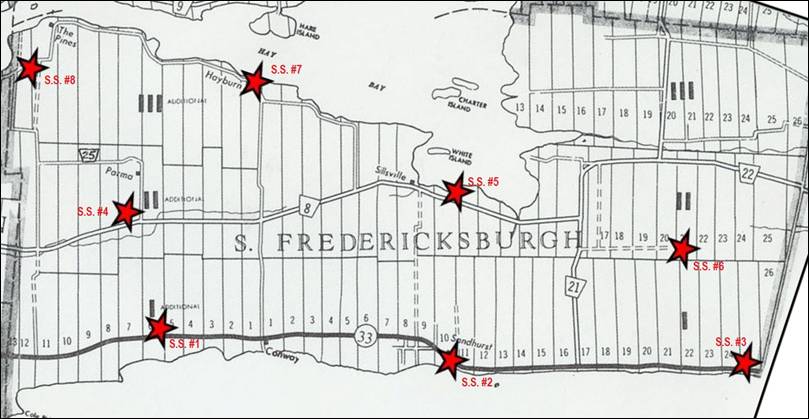
Location of South Fredericksburgh Schools as
indicated on the 1860 Wallings’ Map |
|
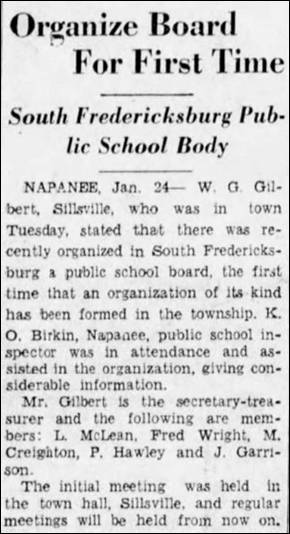
Until 1940, each
school section was run by a separate board. In 1940, a single
township board was formed to run all schools in the municipality. |
|
|
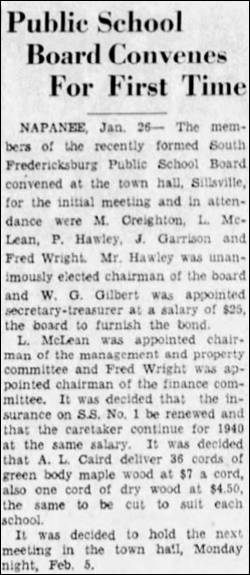
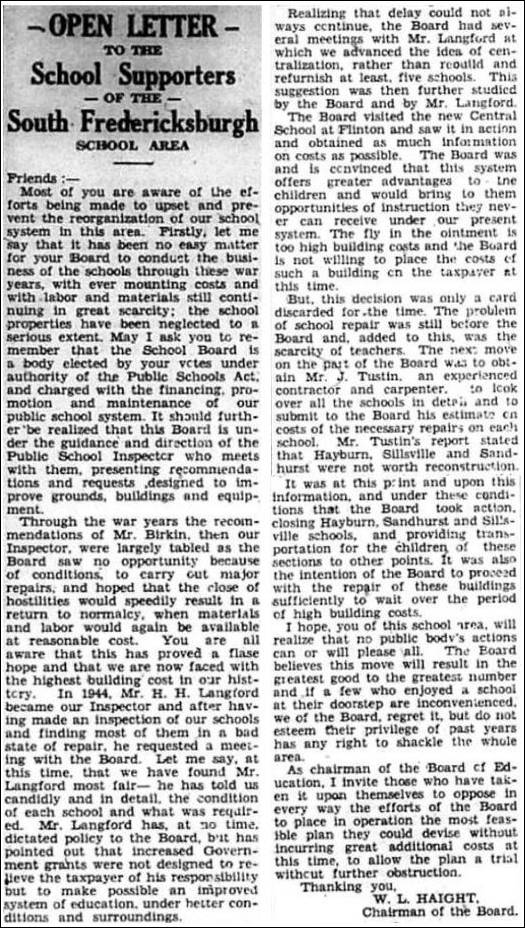
The ‘New’ Public School Board in South
Fredericksburgh 1940 |
|
|
January 24 1940, Kingston Whig Standard |
January
26 1940, Kingston Whig Standard |
|
June 26 1946, Napanee Beaver |
|
|
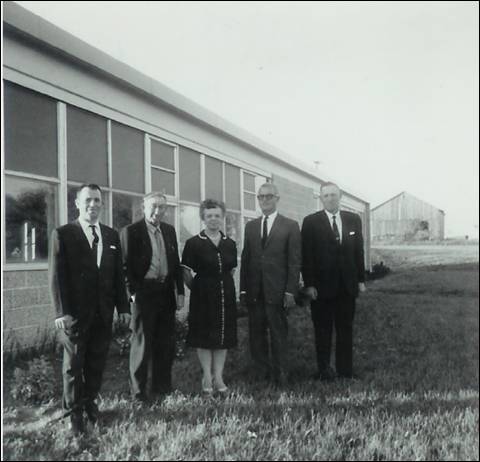
South Fredericksburgh Public School Board 1964 (L-R): Ross
Powell, Wilfred Haight, Marjorie Young, Walter F. Gilbert, Donald Hough William Myers
(absent) |
|